 Skip to content
If you’re considering an InBody Scan, you’ve probably wondered:
“How accurate is it?”
It’s an excellent question.
After all, if you’re making decisions about your health, body fat, muscle mass, or medical weight loss progress, you want to know that the information you’re receiving is meaningful.
The short answer is yes—the InBody 570 is considered one of the most advanced medical-grade bioelectrical impedance analyzers available today.
However, understanding what an InBody Scan actually measures—and what influences your results—is just as important as understanding its accuracy.
At The Best Injector, we use the InBody 570 because it provides detailed body composition information that helps patients track meaningful progress over time instead of relying only on body weight.
Many people assume accuracy means receiving the exact same number every single time.
Body composition doesn’t work that way.
Your body naturally changes throughout the day.
Things that can temporarily influence measurements include:
The goal isn’t to eliminate every small variation.
The goal is obtaining consistent, reliable measurements over time so trends can be accurately monitored.
That is where the InBody 570 performs exceptionally well.

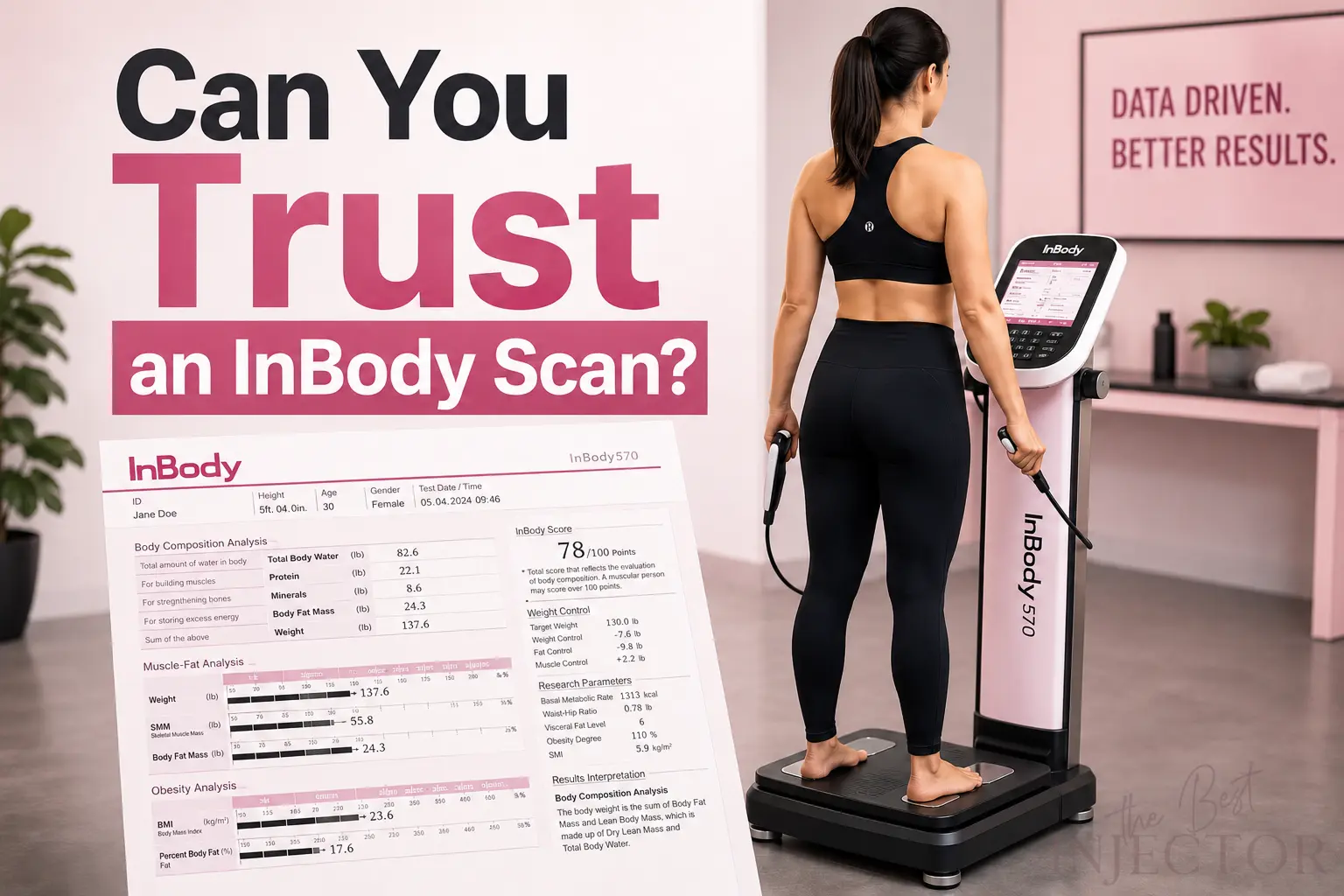
The InBody 570 uses advanced multi-frequency bioelectrical impedance analysis (BIA).
A very small electrical current passes safely through your body.
Different tissues conduct electricity differently.
For example:
Muscle contains a large amount of water and conducts electricity very efficiently.
Fat contains much less water and resists electrical flow.
By measuring how electrical current travels through different areas of your body, the InBody 570 estimates:
Rather than producing a single number, the scan creates a comprehensive picture of your body composition.
Not all bioelectrical impedance devices are created equally.
Many consumer smart scales only measure from one foot to the other.
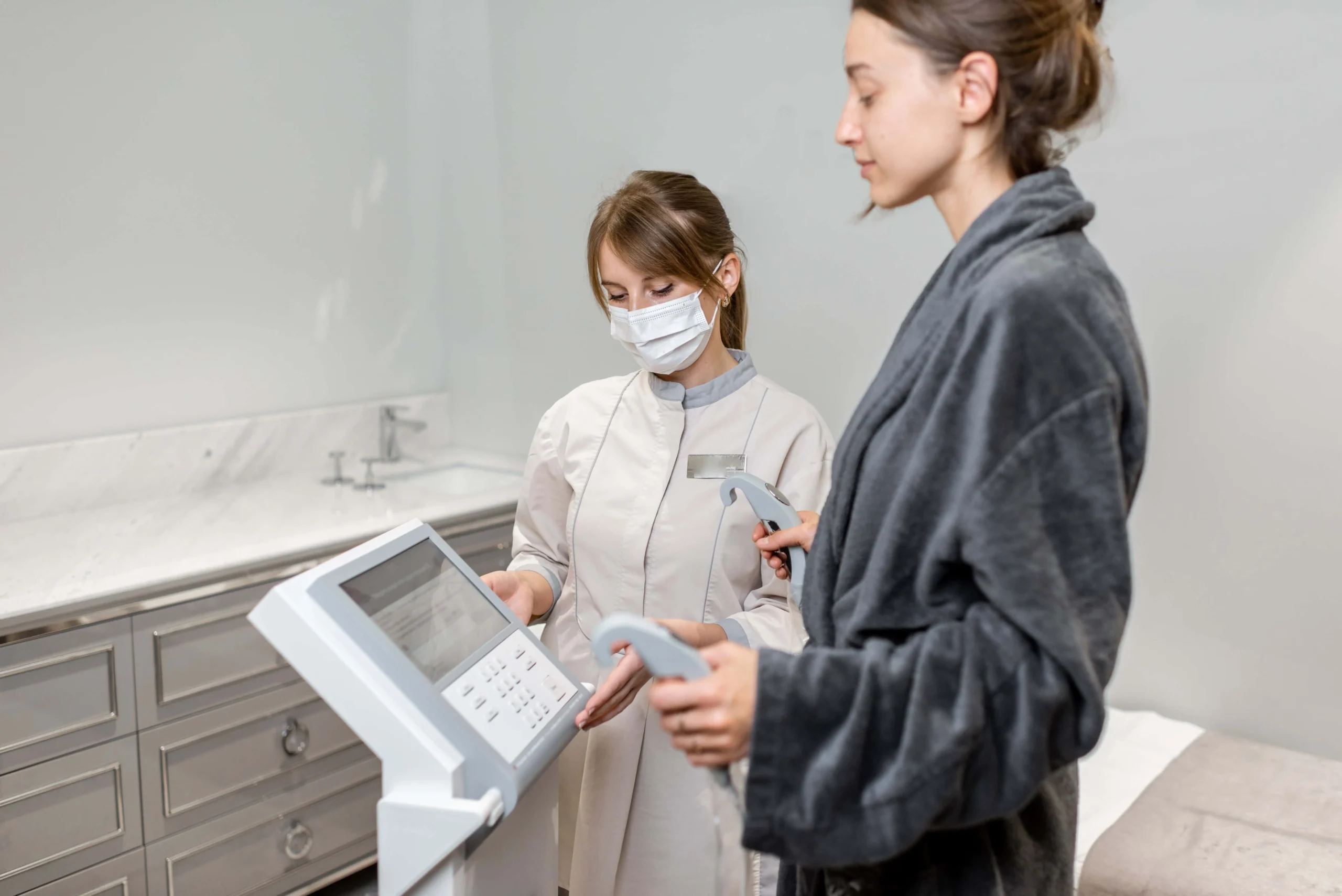
The InBody 570 uses eight-point tactile electrodes, allowing it to measure through both the hands and feet while analyzing each limb and the trunk separately.
It also uses multiple frequencies instead of relying on a single frequency.
This provides a more detailed evaluation of body composition and improves consistency when measurements are performed under similar conditions.
This is another question we hear frequently.
DEXA (Dual-Energy X-ray Absorptiometry) has long been considered one of the reference methods for evaluating body composition and bone density.
However, DEXA and InBody technology are designed for different purposes.
DEXA is commonly used for:
The InBody 570 is designed for:
While DEXA may provide slightly different measurements, the greatest strength of the InBody 570 is its ability to deliver fast, repeatable results without radiation exposure, making it practical for regular monitoring.
Many patients become overly focused on whether one scan shows 27.8% body fat while another shows 28.2%.
In reality, those small differences are far less important than the overall trend.
For example:
Body Fat
34%
Muscle
58 lbs
Body Fat
31%
Muscle
58 lbs
Body Fat
28%
Muscle
59 lbs
That tells an excellent story.
Body fat is decreasing.
Muscle has been preserved.
Even if each individual measurement isn’t mathematically perfect, the overall trend provides valuable clinical information.
This is exactly why healthcare providers focus on body composition trends rather than a single measurement.

To obtain the most reliable results, it’s important to test under similar conditions each time.
We recommend:
By following these recommendations, repeat measurements become much more meaningful.
Because body composition analysis has become more popular, there are also many misconceptions about what an InBody Scan can and cannot do.
Let’s look at a few of the most common myths
This is one of the most common misunderstandings.
Weight and body composition are not the same thing.
It’s entirely possible to maintain the same body weight while losing body fat and gaining muscle. Since muscle is denser than fat, your weight may remain relatively stable even as your body composition improves.
An InBody Scan helps identify these positive changes that a traditional scale cannot detect.
Body composition naturally fluctuates throughout the day.
Changes in hydration, meals, sodium intake, exercise, alcohol consumption, and even sleep can temporarily affect certain measurements.
This is why we recommend repeating scans under similar conditions whenever possible. Consistency in testing is more important than comparing isolated measurements.
While many smart scales estimate body fat using bioelectrical impedance, they typically rely on foot-to-foot measurements and simplified prediction equations.
The InBody 570 is a medical-grade body composition analyzer that uses multi-frequency technology and eight-point tactile electrodes to evaluate the body more comprehensively.
For patients monitoring medical weight loss, muscle preservation, or long-term body composition changes, the additional information provided by the InBody 570 is significantly more useful than weight alone.
An InBody Scan can benefit almost anyone interested in better understanding their health, but it is particularly valuable for:
Whether your goal is losing body fat, maintaining muscle, improving athletic performance, or simply understanding your body better, an InBody Scan provides valuable information that can help guide your decisions.

At The Best Injector, body composition analysis is an important part of our medical weight loss program.
Rather than celebrating weight loss alone, we focus on improving body composition.
During treatment, we want to see:
This allows patients to see meaningful progress that extends far beyond the number on the scale.
Many patients ask whether they can simply use a smart scale at home.
Smart scales can be useful for monitoring general trends, but they are not designed to replace medical-grade body composition analysis.
A smart scale primarily estimates body composition based on measurements taken through the feet.
The InBody 570 measures multiple body segments using advanced multi-frequency technology through both the hands and feet, providing a more comprehensive analysis of muscle mass, body fat percentage, body water, and visceral fat.
For patients actively participating in a medical weight loss program, these additional measurements provide much more meaningful information for monitoring progress.
Body Mass Index (BMI) has been used for decades as a simple screening tool based on height and weight.
However, BMI cannot distinguish between fat and muscle.
For example, two people may have identical BMIs while having dramatically different amounts of body fat and muscle mass.
An InBody Scan provides a much more complete picture by evaluating:
This allows healthcare providers to make more personalized recommendations based on actual body composition rather than body weight alone.
Perhaps the greatest strength of the InBody 570 is its ability to monitor changes over time.
One scan provides a snapshot.
Multiple scans provide a story.
Over several weeks or months, patients can see:
This trend analysis often provides much more valuable information than any single measurement.
No body composition test is perfect.
However, when performed under consistent conditions, the InBody 570 provides highly reliable information that helps patients and healthcare providers monitor meaningful changes over time.
Rather than asking whether the number is perfect, the better question is:
“Is this helping me make better decisions about my health?”
For most patients, the answer is yes.
Body composition analysis provides insights that a traditional scale simply cannot offer, allowing you to focus on losing body fat, preserving muscle, and improving your overall health.
Whether you’re beginning a medical weight loss program, taking semaglutide or tirzepatide, or simply looking for a more meaningful way to monitor your health, an InBody Scan can provide valuable information about what’s happening beneath the surface.
Schedule your consultation today to learn how the medical-grade InBody 570 can help you track body fat, muscle mass, metabolism, and long-term progress with confidence.
The InBody 570 is considered a medical-grade body composition analyzer that provides highly reliable measurements when testing is performed under consistent conditions. It is widely used by healthcare providers, medical weight loss clinics, fitness professionals, and research settings to monitor body composition over time.
The InBody 570 provides a more comprehensive analysis than most consumer smart scales by using advanced multi-frequency technology and measuring multiple body segments through both the hands and feet. While smart scales can be useful for tracking general trends at home, the InBody 570 offers more detailed information for monitoring body composition.
DEXA and InBody technology measure body composition differently and each has its own advantages. DEXA is commonly used for bone density evaluation, while the InBody 570 is designed for practical, repeatable body composition monitoring without radiation exposure. Both can provide valuable information depending on your goals.
Yes. Hydration status can influence body composition measurements. For the most consistent results, we recommend testing under similar conditions each time and maintaining normal hydration.
Fasting is not required, but avoiding food for approximately two to three hours before your scan can help improve consistency.
Strenuous exercise immediately before testing may temporarily affect body water distribution. We recommend avoiding intense workouts before your appointment whenever possible.
The scan itself takes approximately 60 seconds. Reviewing your results typically requires only a few additional minutes.
Yes. The InBody 570 uses a very low-level electrical current that is generally considered safe for most healthy adults. Individuals with implanted electronic medical devices, such as pacemakers, should not undergo bioelectrical impedance testing unless advised otherwise by their healthcare provider.
Patients participating in medical weight loss or fitness programs often benefit from repeating an InBody Scan every four to eight weeks to monitor changes in body composition.
Yes. The InBody 570 estimates visceral fat levels, providing additional information about metabolic health that cannot be obtained from body weight alone.
Lianne uses standardized preparation and repeat InBody 570 measurements to obtain more consistent body-composition data and evaluate meaningful trends over time.